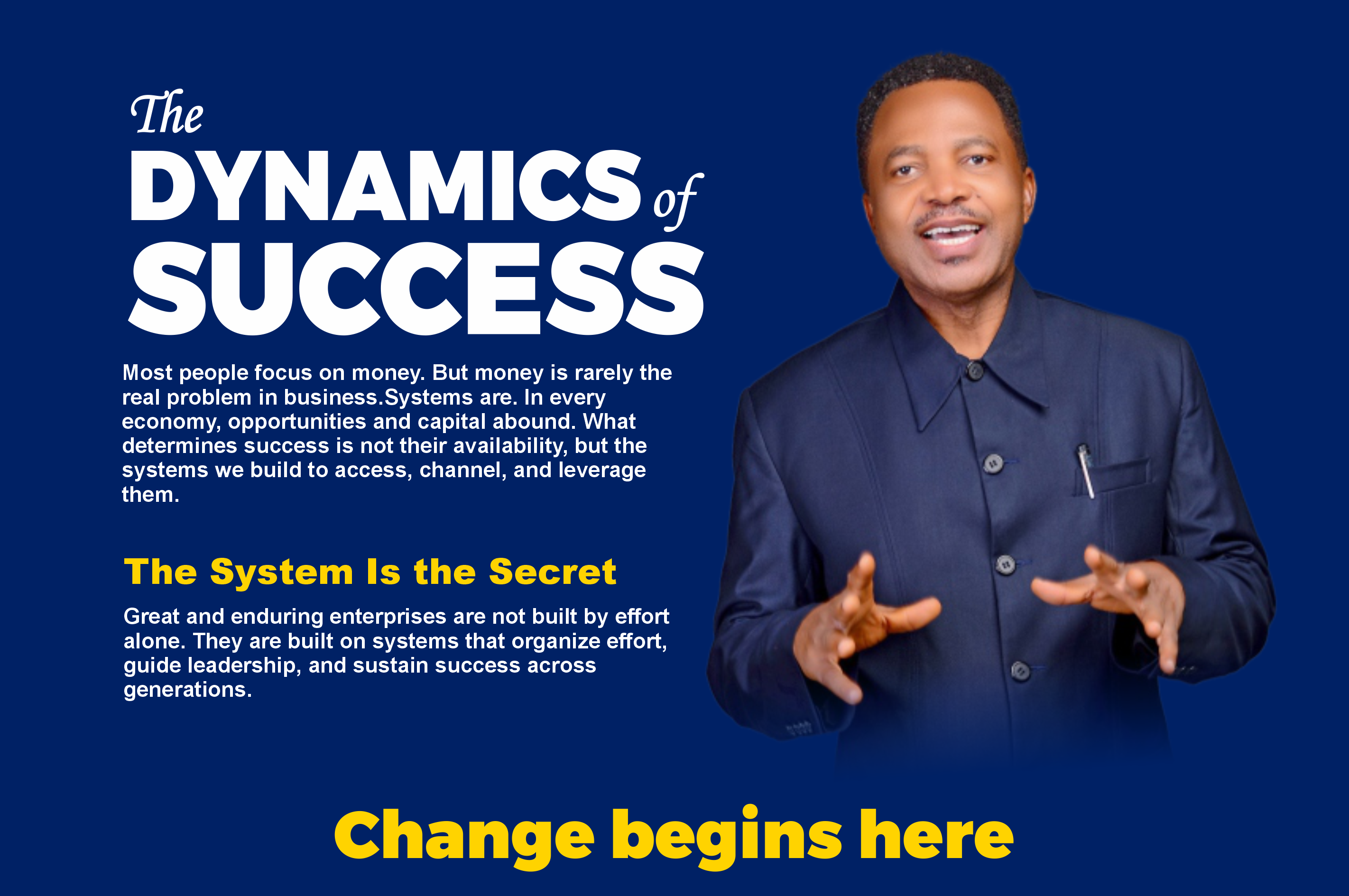

This truth has been staring us in the face for more than three decades. Most entrepreneurs believe the primary challenge in business is money. In reality, the deeper challenge is how the business is structured, organized, managed, and led. Most businesses are personality-driven. Enduring companies operate differently. They rely on systems that coordinate people, decisions, and resources—enabling consistent performance and the ability to seize opportunity.
What is rarely articulated, however, is that enterprise longevity emerges at the intersection of three forces shaped by entrepreneurial wisdom: Systems Thinking. Systems Dependency. Systems Conscientiousness.
A business becomes durable when these forces are deliberately developed and consistently applied. The system that integrates them is the business itself.
We have seen promising businesses rise with pride and high expectations—only to collapse, often suddenly. The consequences are severe: life savings lost, assets liquidated, and years of sacrifice undone. Yet the greater tragedy is that many founders never fully understand what went wrong.
Across industries and economies, the pattern is consistent. Most failures do not stem from a lack of capital or opportunity, but from internal disorganization—dysfunctional systems, unclear responsibilities, inconsistent operating procedures, weak governance, and limited executive capacity.
More money rarely solves these systemic problems.
More often, it magnifies them.
Every serious founder eventually confronts the same question: How do we build profitable businesses without burning out people, exhausting goodwill, eroding culture, or compromising our vision, values, and future?
Many attempt to solve this through greater effort, more capital, or new technology. But the real answer lies in systems, processes, and governance. The way a business organizes its strategy, operations, leadership, and culture determines whether it merely survives—or truly endures.
When these systems are properly designed and applied, they produce three essential outcomes:
Wellness -
Protects people from burnout and sustains creativity and innovation.
Wellbeing -
Strengthens culture, governance, and institutional stability.
Wealth -
Delivers sustainable financial performance and long-term enterprise value.
If your business cannot run effectively without your constant involvement, it will struggle to survive when you step aside. The reason is almost always a systems problem.
Discover why the system is the business—and uncover what may be constraining your enterprise.
Schedule a Strategy Session
Learn More
Scaling your business for growth, sale, or succession
shouldn’t be a mystery—or a nightmare.
We’ll show you how to do it—the right way.
So you can build your own economy and be in business for yourself—not by yourself.
Our Strategy Counseling Sessions help entrepreneurs and leadership teams gain the clarity required to build systems that streamline operations, make results predictable, and reduce dependence on any single individual.
We also help leaders strengthen the internal dynamics that drive over 80% of results—including executive functions, executive presence, executive expression, and executive performance—the four core capabilities that determine the personal effectiveness required for leadership and sustained growth.

The defining difference between generational enterprises and most other businesses is their commitment to three institutional capabilities:
Together, these capabilities form the foundation of enterprise performance, sustainability, and continuity.
Through The SME Board™, we guide entrepreneurs to systematize, streamline, and scale their businesses—while reducing leadership anxiety—through structured advisory services, training, and disciplined oversight, even in turbulent commercial environments.

Why do some companies endure for generations while most businesses—especially SMEs and family businesses, struggle to scale and rarely outlive their founders?
Many assume the difference is capital, talent, or size. It is not. The real differentiators are systems thinking, systems dependency, and systems conscientiousness. Without this triad, even promising enterprises become trapped in hustle, firefighting, stress, and eventual burnout.
Most businesses fail not because opportunities are scarce, but because their operations, decisions, and governance remain weak, inconsistent, or founder-dependent.
Growth does not come from effort alone. It comes from systems that align strategy, processes, people, and technology to consistently turn resources into value and superior customer outcomes—even in turbulent times.
The SME Board™ helps you build those systems. With local and virtual support, we help you create a business that can scale, endure, and work for you—not because of you.
Discover why systems create scalable businesses—and identify the constraints limiting your growth.
Learn More




What sets champions apart from everyone else, even leaders? Champions are ChangeMakers. They are visionaries driven by worthy ideals, focusing on what could be rather than what is. They strive for the highest good of all, often at their own risk. This mindset is best described by George Bernard Shaw’s famous quote, “The reasonable man adapts himself to the world; the unreasonable one persists in trying to adapt the world to himself. Therefore, all progress depends on the unreasonable man.”
Learn more


Consul General, U.S. Consulate General, Lagos, Nigeria
Anayo has shown exemplary leadership and the U.S. Government appreciates him.

MIGFO/ PTOL
In every relationship, whether personal or business, I value attitude, character, and competence. On all three counts, Anayo Agu has been exceptional throughout our over two-decade relationship. From his days at the U.S. Commercial Service to his role as a consultant and Strategic Business Adviser for MIGFO Nigeria Ltd and PTOL, Anayo has consistently demonstrated integrity and expertise. Our long-standing partnership is a testament to the fact that nothing moves faster than the speed of trust.

International Business Consultant (CEO)
You can take his counsel to the bank I’ve known the Co-Founder/CEO of Seeds of Greatness Institute for over 20 years. During this period, he has shown unwavering commitment and extraordinary consistency in facilitating strategic alliances between Nigerian and US companies.

Integrated Grain Processors (Nig) Ltd. (Managing Director)
I Endorse Seeds of Greatness Institute because the best way to give is to Empower. My name is Dr Chris Chiwetelu. I am the managing director and chief executive officer of Integrated Grain Processors (Nig) Ltd.

(President National Association of Small Scale Industrialists at NASSI Enugu chapter) Managing Director
We are strategic partners. Seeds of Greatness is a champion of financial literacy and entrepreneurship in our geopolitical zone. It’s directors are respected professionals with rich and extensive public and private sector experience. As one of our strategic partners, I recommend the Institute’s training and development programmes.

InterHauls Services (CEO)
Character really counts. Unlike most public funds that end up in bank account of the friends of the person in charge. Anayo guided us with entreprenual training programs, business advices and left an open door we can always walk in to get personalized advise on a particular issues.


